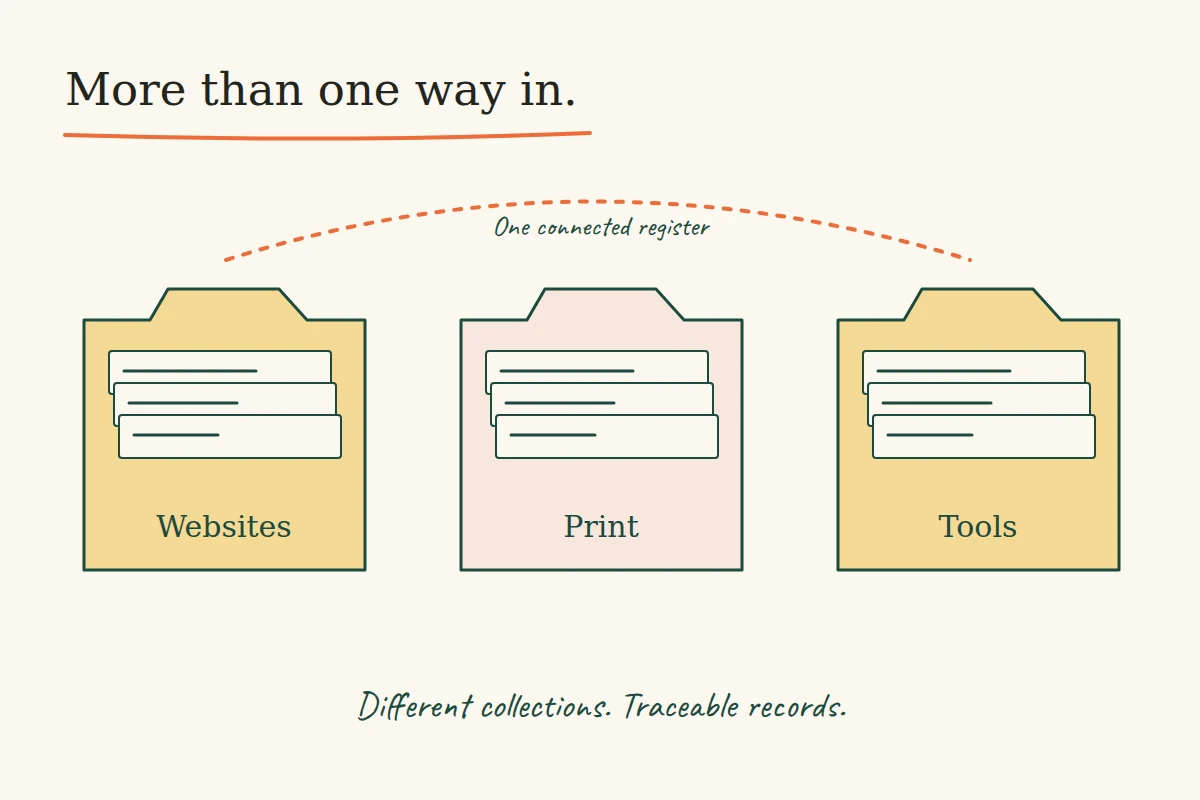
Original conceptual illustration of grouped records. No historical website interface is shown.
The former portfolio used overlapping labels for its projects: a website could appear under HTML5, responsive design and WordPress at once. This guide reunites memberships found in 39 substantive listing captures. It leads to the 45-project register, where each record states how much evidence survives.
The groups combine different archived versions; they do not reproduce a single complete historical catalogue, its exact pagination or its sorting controls. A category label records what the old site called a project, not a current technical or accessibility certification.
Browse the collections
- Brochures — 2 records
- Business cards — 8 records
- Catalogues — 1 record
- Custom CMS — 2 records
- Flyers — 1 record
- HTML5 themes — 25 records
- Logos — 1 record
- Parallax — 9 records
- Posters — 1 record
- Responsive websites — 23 records
- Signage and banners — 5 records
- Transparent cards — 1 record
- Website development — 11 records
- WordPress — 20 records
- jQuery plugins — 1 record
See also the website selection, print selection and historical author archives.
Website selection
- 5xtrade lead-collection website
- Amitesh Biswas website
- Andaman Tour Online website
- Aptsource Software website
- BRAY website theme
- Creole Studios template
- DOCTORS ON CLICK website
- EXAMSLIVE website
- Fredegårds real-estate template
- Ganesh Sweets website
- Glamour World website
- Global Health Care
- iOttie website
- KIC Metaliks website
- L & H Group Foundation
- Limitless Learning website
- Lysmarine AB
- Mind World Academy website
- NuBooking template
- Online Andaman website
- Optimum Health Care Solutions website
- Satavic Farms website
- Surgical OT Light website
- Switchit Technologies website
- The Wondery
Print and identity selection
- 8 METER MEDIA business cards
- Aurora Sky Homes business cards
- Aurora Sky Homes logo
- Bhraman Tours & Travels business cards
- Durga Puja promotional banner
- FashionQe banner
- Moore Minerals business card
- Nature Hill Top Resort brochure
- Paanchajanya banner
- Riant Fitness Studio banner
- Ripple Group business card
- Ripple Group transparent business card
- Sangeet / Sanjeet Sangha
- SWICHIT LED posters
- Switchit LED lighting catalogue
- Tabla-player business card
- Titlis Developers bi-fold brochure
- Titlis Developers business card
- Titlis Developers single-page flyer
Brochures
Business cards
- 8 METER MEDIA business cards
- Aurora Sky Homes business cards
- Bhraman Tours & Travels business cards
- Moore Minerals business card
- Ripple Group business card
- Ripple Group transparent business card
- Tabla-player business card
- Titlis Developers business card
Catalogues
Custom CMS
Flyers
HTML5 themes
- 5xtrade lead-collection website
- Amitesh Biswas website
- Andaman Tour Online website
- Aptsource Software website
- BRAY website theme
- Creole Studios template
- DOCTORS ON CLICK website
- EXAMSLIVE website
- Fredegårds real-estate template
- Ganesh Sweets website
- Glamour World website
- Global Health Care
- iOttie website
- KIC Metaliks website
- L & H Group Foundation
- Limitless Learning website
- Lysmarine AB
- Mind World Academy website
- NuBooking template
- Online Andaman website
- Optimum Health Care Solutions website
- Satavic Farms website
- Surgical OT Light website
- Switchit Technologies website
- The Wondery
Logos
Parallax
- 5xtrade lead-collection website
- Amitesh Biswas website
- Andaman Tour Online website
- Aptsource Software website
- Ganesh Sweets website
- iOttie website
- Satavic Farms website
- Switchit Technologies website
- The Wondery
Posters
Responsive websites
- 5xtrade lead-collection website
- Amitesh Biswas website
- Andaman Tour Online website
- Aptsource Software website
- Creole Studios template
- DOCTORS ON CLICK website
- EXAMSLIVE website
- Fredegårds real-estate template
- Ganesh Sweets website
- Glamour World website
- Global Health Care
- iOttie website
- KIC Metaliks website
- Limitless Learning website
- Lysmarine AB
- Mind World Academy website
- NuBooking template
- Online Andaman website
- Optimum Health Care Solutions website
- Satavic Farms website
- Surgical OT Light website
- Switchit Technologies website
- The Wondery
Signage and banners
- Durga Puja promotional banner
- FashionQe banner
- Paanchajanya banner
- Riant Fitness Studio banner
- Sangeet / Sanjeet Sangha
Transparent cards
Website development
- 5xtrade lead-collection website
- Andaman Tour Online website
- Aptsource Software website
- DOCTORS ON CLICK website
- EXAMSLIVE website
- Glamour World website
- KIC Metaliks website
- Limitless Learning website
- Mind World Academy website
- Optimum Health Care Solutions website
- Surgical OT Light website
WordPress
- Amitesh Biswas website
- Andaman Tour Online website
- Aptsource Software website
- BRAY website theme
- Creole Studios template
- DOCTORS ON CLICK website
- EXAMSLIVE website
- Fredegårds real-estate template
- Ganesh Sweets website
- Glamour World website
- KIC Metaliks website
- L & H Group Foundation
- Limitless Learning website
- Mind World Academy website
- NuBooking template
- Online Andaman website
- Optimum Health Care Solutions website
- Satavic Farms website
- Switchit Technologies website
- The Wondery
jQuery plugins
Historical author archives
These groups reproduce membership observed under the old account paths. A WordPress byline is not proof that one person independently created every part of a commission. These historical names are not presented as the journal’s current contributors.
The old admin archive
The captured admin-path archive is headed Sukanta Paul. Other early cards display the generic label “admin”; the register preserves those labels without silently converting them into a personal credit.
- 8 METER MEDIA business cards
- Amitesh Biswas website
- Bhraman Tours & Travels business cards
- BRAY website theme
- Fredegårds real-estate template
- Lysmarine AB
- Paanchajanya banner
- The Wondery
- Titlis Developers bi-fold brochure
- Titlis Developers single-page flyer
Sources: 2014 capture 1.
Mita Samanta archive
- 5xtrade lead-collection website
- DOCTORS ON CLICK website
- EXAMSLIVE website
- Glamour World website
- Limitless Learning website
- Mind World Academy website
- Optimum Health Care Solutions website
- Surgical OT Light website
Sources: 2018 capture 1.
Sukanta Paul archive
- 8 METER MEDIA business cards
- Amitesh Biswas website
- Aurora Sky Homes business cards
- Aurora Sky Homes logo
- Bhraman Tours & Travels business cards
- BRAY website theme
- Creole Studios template
- Durga Puja promotional banner
- FashionQe banner
- Ganesh Sweets website
- iOttie website
- L & H Group Foundation
- Moore Minerals business card
- Nature Hill Top Resort brochure
- NuBooking template
- Online Andaman website
- Paanchajanya banner
- Riant Fitness Studio banner
- Ripple Group business card
- Ripple Group transparent business card
- Sangeet / Sanjeet Sangha
- Satavic Farms website
- SWICHIT LED posters
- Switchit LED lighting catalogue
- Switchit Technologies website
- Tabla-player business card
- The Wondery
- Titlis Developers bi-fold brochure
- Titlis Developers business card
- Titlis Developers single-page flyer
- UFXD fixed-height image slider
Sources: 2016 capture 1, 2019 capture 2.
What the collections leave unresolved
Some archived filter addresses returned an empty collection or a verification screen. They add no project text to this guide. Where an old filter label and category identity are documented, its address can lead to the corresponding reconstructed group, with no claim that its original result set was recovered.
The 257-row source register keeps the captured memberships and date strings available for comparison. Twenty-five project identities have displayed timestamps whose timezone offsets differ between sources. We retain both strings and do not infer a single publication instant or delivery chronology.