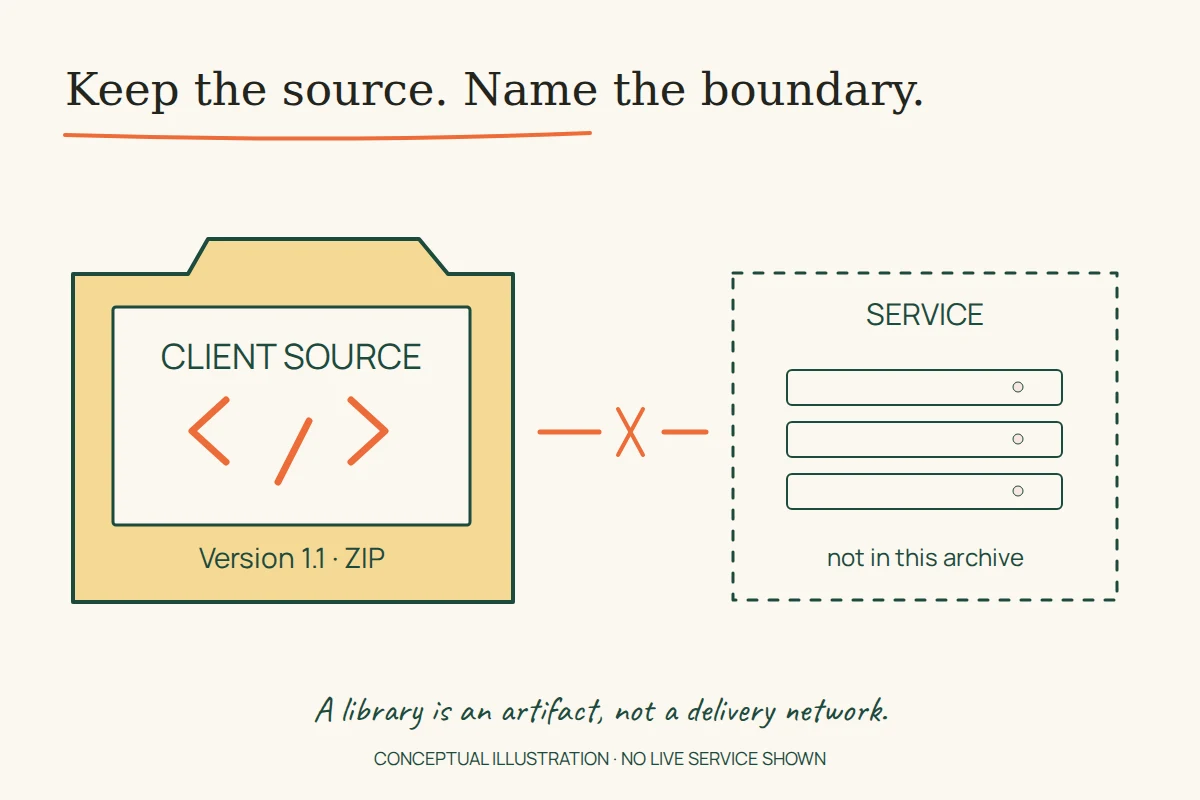
A small client library can survive without a working service behind it. That is the case worth keeping clear in the recovered Uflix SMS SDK: the PHP source is available, while a working messaging account, gateway and delivery network are not part of the archive.
We retrieved the public source archive for uflixdesign/sms-api-sdk version 1.1, pinned to commit 0f6a6accbdbde8ffc51a831e0a750ab11b816636. The package metadata dates that version to 31 January 2020. Its five files include the client class, README, Composer metadata, licence and a Git ignore file. The archive is preserved unchanged for historical inspection.
The source package
- Download the original version 1.1 ZIP — 18,060 bytes.
- Read the source and checksum record, including the archive’s SHA-256 and individual file hashes.
- Read the included GNU GPL licence. The package declares
GPL-3.0-or-later.
The original UFLIX DESIGN author credit remains in the source. The current publication is preserving that work, not claiming its authorship or offering its former SMS service. The source package has not been installed as a WordPress plugin or connected to an account.
What the client actually contains
src/Client.php defines a PHP client with a configurable base URL and API version. Its public methods cover a gateway-status request, balance lookup, sending a message, requesting a one-time code and verifying that code. The source includes request construction and response handling; it contains no SMS delivery infrastructure or server-side verification store.
The API paths make that boundary visible. The client builds versioned requests for api-status, account/balance, sms, otp and otp/verify. Those are historical client expectations. The archive does not establish that any corresponding endpoint is operating now.
The README and implementation disagree
The README describes configuration in terms of Guzzle request options. In this pinned version, the implementation uses PHP cURL calls, and composer.json requires the cURL extension. It does not declare a Guzzle dependency. A reader trying to understand this version should follow the actual configuration keys and code rather than assume that every Guzzle option is supported.
There is another important boundary in the defaults. The supplied base address uses plain HTTP, and the request helpers configure HTTP Basic authentication. This archive does not recommend submitting credentials to that historical address. No status, balance, message or OTP request was made during this recovery.
A local return value is not a delivery result
The method named APIStatus returns true after a successful request path through its helper; a caught exception normally produces false unless the caller asks for an exception. The balance method catches exceptions and returns null on failure. The OTP methods similarly convert caught exceptions into false.
Those return paths do not establish delivery to a phone. More narrowly, they show how this client interprets a response or failure. A status request cannot establish the outcome of a separate delivery, and a boolean from an OTP call is not a recovered server log.
The original README includes approximate reliability percentages for named routes. We have retained that document inside the unmodified source package, but those figures are historical publisher claims. This recovery provides no delivery measurements, test sample or current service guarantee.
What the OTP code does—and does not—prove
The request method accepts an action name, phone number, optional message and a time-to-live value whose default is five. The README describes that value in minutes. The client forwards those fields; this source does not contain the server logic that would enforce expiry or generate and store the code.
Similarly, verification sends an action, number and code to the gateway. Reading that request helps explain the interface contract, but it cannot confirm the old service’s rate limits, storage, expiry enforcement or handling of overlapping requests. Those would require server-side evidence absent from this package.
How the recovered files were checked
The download came from the public GitLab repository at the exact commit identified by the package metadata. We checked the ZIP’s member integrity, recorded each file hash and read the source and documentation. The commit was checked against the repository API. These are source-provenance checks, not a runtime compatibility or security audit.
For historical comparison, keep the commit alongside any observation. A changed README or a later branch could describe different behaviour. Start with the package boundary—client source here, service infrastructure elsewhere—and the small archive becomes useful without pretending to restore a messaging business.
Primary sources: the pinned source tree and the package’s published version metadata. For a related design question, see why a request and a confirmed outcome need different labels.