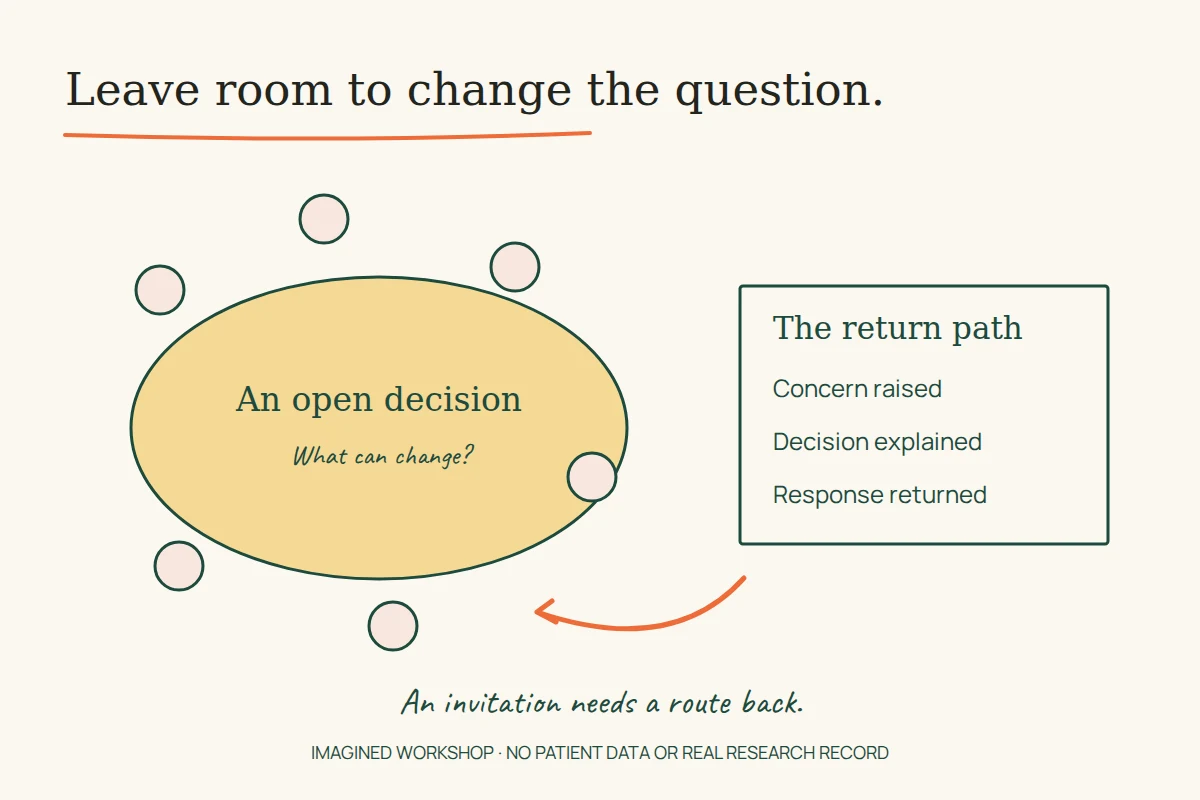
A workshop can invite patients into the room and leave every important decision somewhere else. The attendance list will look inclusive. The process may still give people no way to alter the question, challenge an assumption or hear what happened afterwards.
A series of Inobi reports from a September 2017 conference on future clinical studies raises this problem in several forms: the role of patient organisations, shared research infrastructure, collaboration between institutions and a speculative patient in 2030. The old Uflix demo linked to these reports. Their surviving publisher versions offer useful material for a design question: where, exactly, can a contributor change the work?
Read the event report as an event report
The opening conference report connects Inobi’s attendance with its work around Sahlgrenska Life and discusses the need to make collaboration concrete. It is a participant’s account of a 2017 event. Its funding discussions, organisational descriptions and forecasts describe the 2017 setting.
This distinction is useful when turning an event into a design brief. Record what the speaker proposed, what the reporter observed and what the project can actually implement. The three may be related, but one does not automatically prove the next. An enthusiastic speech can identify a worthwhile direction without supplying an operating model.
Begin with a decision that is still open
In the first patient-focused report, Inobi attributes to Silke Mader a case for earlier involvement and several possible roles beyond being a study participant. It also records her concern that people may contribute to research without learning what it produced.
Those are two connected design requirements: influence before a decision is fixed, and feedback after a contribution is made. A proposed invitation should explain which choices remain open. “Help us improve this information sheet” offers a different role from “Help us decide which question this study should address.” Neither should be presented as the other.
NIHR’s Midlands Patient Safety Research Collaboration describes public involvement as partnership in research, with examples including identifying priorities, shaping projects, improving documents and sharing results. That current explanation helps distinguish contributing to the design of research from simply supplying data within it. This article concerns those participation processes, not advice on enrolling in a study or choosing treatment.
Henna in 2030 is a scenario, not a patient record
The second patient report describes a panel’s imagined future patient, Henna, and explores trust, information sharing and the usefulness of research data to patients themselves. It also records proposals about patient organisations taking a stronger role in research governance.
The scenario can reveal dependencies without being a prediction. If an imagined service assumes that a person shares daily information, its designer must ask what happens when that assumption fails. Can the person understand what is requested? Can they correct an error? What support exists when the digital channel is unavailable? These are questions for a proposed service, not claims that the panel’s imagined system exists.
A practical workshop could place each assumption on a separate card. Mark its status as observed, supported by a source, proposed or unresolved. Then select one assumption to investigate. This keeps an appealing future story from quietly turning into a specification made entirely of untested promises.
Map the handover between institutions
The infrastructure report surveys resources discussed by Jan Andersson, ranging from research facilities and information services to registries and coordination. It includes hopes and developments described at the time. Reproducing the list as a current set of available services would erase that date and context.
As a design exercise, replace an institutional map with one concrete handover. Imagine a team needs to find an appropriate source of project support. A useful map would show the question to ask, the receiving role, the information required and the response the team can expect. Drawing a line between two organisation logos supplies none of those details.
That is also where a gap becomes visible. If nobody is responsible for explaining the next step, the user experiences a dead end even when every organisation in the diagram is functioning. The diagram should make that uncertainty conspicuous rather than hide it under an arrow labelled “collaboration.”
Translate collaboration into a handover
The companion policy report centres on collaboration between sectors and the challenge of bringing research knowledge into practice. Its account of Karin Röding’s remarks belongs to 2017. The durable design question is how responsibility moves between people with different priorities and vocabularies.
For a clearly hypothetical workshop, use this small record: a concern raised, the decision it could affect, the person who will consider it and the way the response will return to the contributor. Add a date only when the team has agreed it. This record can be plain text; it does not require a new platform.
Now test an uncomfortable case. A contributor identifies a problem the project cannot resolve within its remit. The team should still be able to explain that boundary and record the unresolved concern. Calling the contribution “valuable” while losing it in meeting notes provides appreciation without accountability.
Make the return path part of the brief
A participation brief is incomplete if it describes only how people enter. It should also describe what they can influence, how differing views are recorded and how the project reports its decisions back. A changed information sheet can be returned with an explanation of the edits. A broader priority-setting exercise needs a record of the choices and reasons. Choose feedback that lets contributors inspect the decision they helped shape.
That is the useful connection between these five historical reports. Future scenarios widen the questions, infrastructure makes work possible and contributors bring experience that a project team may lack. A concrete process connects them. Without it, the workshop ends where the invitation began: with a promise of involvement that is difficult to inspect.
Related: following a public contribution into a design decision and reviewing claims and appointment actions on a clinic website.
Source note: these are independent design observations based on current Inobi publisher copies, read on 16 November 2026, of reports dated 7 September 2017. They are not a reproduction of the missing demo-page bodies, a clinical review or evidence that the 2030 scenario has occurred.