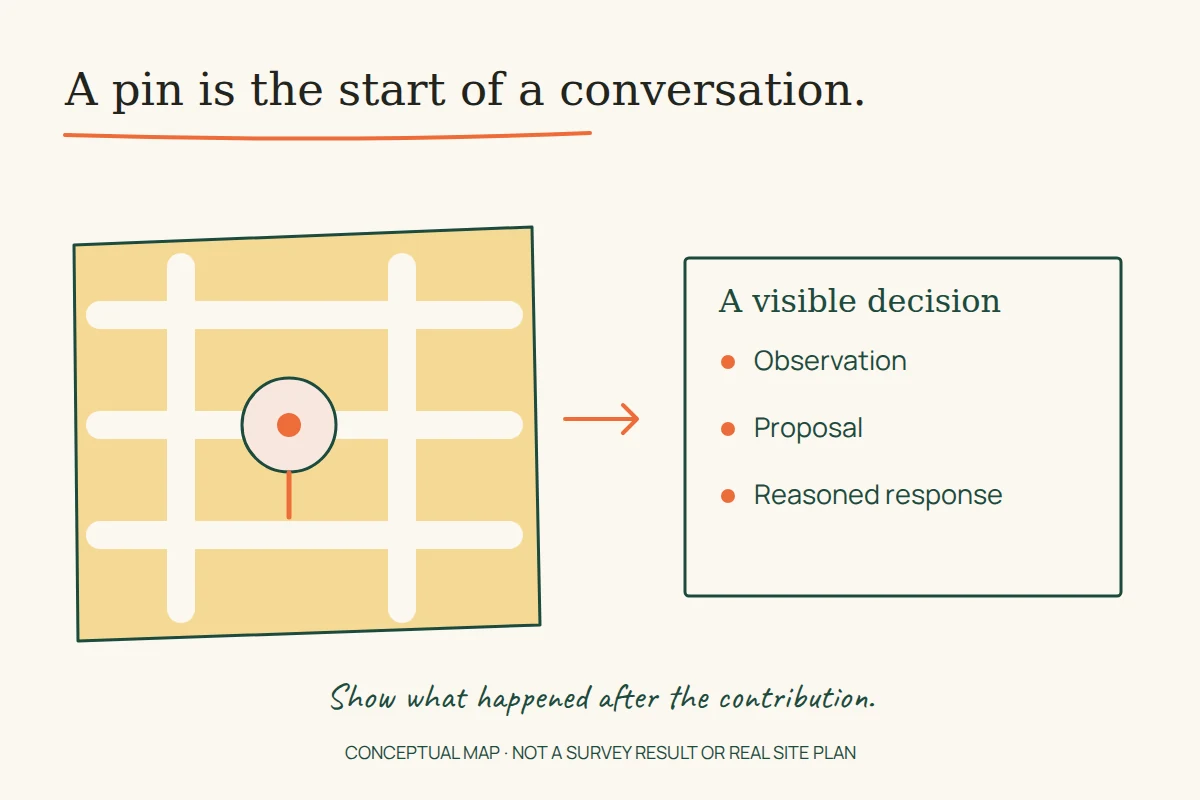
A map full of comments can look like a successful participation project. It does not tell you whose experience is missing, what a comment means or whether any decision will change. The interesting design problem begins after someone drops a pin.
Two references linked from the old Uflix-hosted Inobi demo approach that problem from different directions: a student project on collecting observations of meeting places, and a municipal process for selecting housing proposals. Their original publisher still provides the texts. Read together, they help separate three activities often bundled into one word: observing a place, proposing a change and deciding what gets built.
Separate a location from an interpretation
Inobi’s May 2016 account of Crowdsourcing Urban Planning describes work by Robin Gabre and Adam Szakal. The project explored whether interaction design could support the analysis of physical meeting places. It considered a mobile tool for distributing observational work among contributors.
The authors’ thesis provides an important boundary. Its abstract describes prototypes and discussions with Inobi employees; section 6.3 says informal user testing produced no results concrete enough to report. Its conclusions are therefore proposals and design findings, not a demonstrated city-wide participation outcome.
The useful question is still specific: what should a person report, and what can a device record? A coordinate can locate an observation. It cannot, by itself, explain why the observer avoided a square, whether they recognised a gathering place or how welcome they felt there. Treating location and interpretation as interchangeable loses the reason for collecting both.
A worked example: one bench, three kinds of information
Imagine a proposed survey about a small public square. This is an illustrative exercise, not a field study. A participant reports that they stood beside the north entrance at lunchtime, saw every bench occupied and chose to leave.
Those details should not collapse into a single negative score. The location identifies a place; the time limits the observation; the account of leaving describes one person’s response. A fourth field could ask what would have made staying possible. That is a suggestion, not something the survey has observed.
A useful review screen would keep these layers visible. The project team could group observations made at similar times without converting every busy lunchtime into evidence that the square is always inaccessible. It could display suggested changes separately, so that a popular proposal does not overwrite a less popular but well-documented problem.
The same separation improves the contributor’s interface. Ask a short, answerable question at each step. Explain why a location is needed, provide a way to correct it and allow uncertainty. If someone does not know the name of a space, an approximate description may be more honest than forcing a precise answer.
Tübingen: move from opinions to stated criteria
Inobi’s 2017 Tübingen article describes housing proposals considered in response to refugee accommodation needs. Its value as a design reference lies in the selection process, not in assuming every reported benefit occurred everywhere.
A presentation by Cord Soehlke, PDF page 22, documents approximately 110 applications for 13 sites, fixed land prices and concept-based selection. It lists feasibility, speed, economic effects, later use, integration ideas and value to the neighbourhood among the questions considered. These are historical programme details, not current application terms.
The comparison with the observation app is revealing. Collecting information about a place and selecting a proposal for that place require different interfaces. A comment field may reveal an unmet need. A proposal form must also make the applicant address constraints. A decision record then needs to explain how those answers were weighed.
A hypothetical proposal to add a shared ground-floor room illustrates the gap. “Useful for neighbours” is an intention. A reviewable concept would identify who could enter, what activities it could support, who would manage it and what happens if the intended operator withdraws. These questions do not guarantee success; they turn an attractive phrase into something others can assess.
A building group needs a decision process of its own
Inobi’s building-group explanation presents residents as participants in shaping and commissioning a building. It also emphasises organised stages and support for a complex process. This is the practice’s description of its approach, not independent evidence that a particular group achieved lower costs or stronger community ties.
For a designer, the transferable issue is how a group records choices. If a shared workspace becomes more important than a larger entrance hall, someone should be able to trace when that priority changed and why. A polished final plan conceals the negotiation that produced it; a usable decision history helps later participants understand it.
Close the loop without promising consensus
After collecting contributions, publish a response at the level of detail people can inspect. An illustrative status sequence is: received, grouped with related observations, considered against stated constraints, then accepted, deferred or declined with a reason. A rejected suggestion should not vanish merely because it did not become a design decision.
That record also exposes gaps in the process. Many responses from one street do not demonstrate that every neighbourhood has been heard. A beautifully drawn preference map does not establish how non-participants would answer. Recruitment, language, access and the effort of contributing belong in the project brief alongside the interface.
Good participation design makes the journey from contribution to decision visible. It gives an observation somewhere useful to go, and gives its contributor a way to see what happened. For a smaller-scale example of matching a place to different activities, see our Kuggen learning commons study.
Source note: the Inobi pages were read in their current publisher versions on 16 November 2026. The thesis identifies Gabre and Szakal as its authors; the blog’s body is signed by Szakal despite its current site byline. This article is an independent English analysis, not a full translation or a claim that Uflix conducted either project.