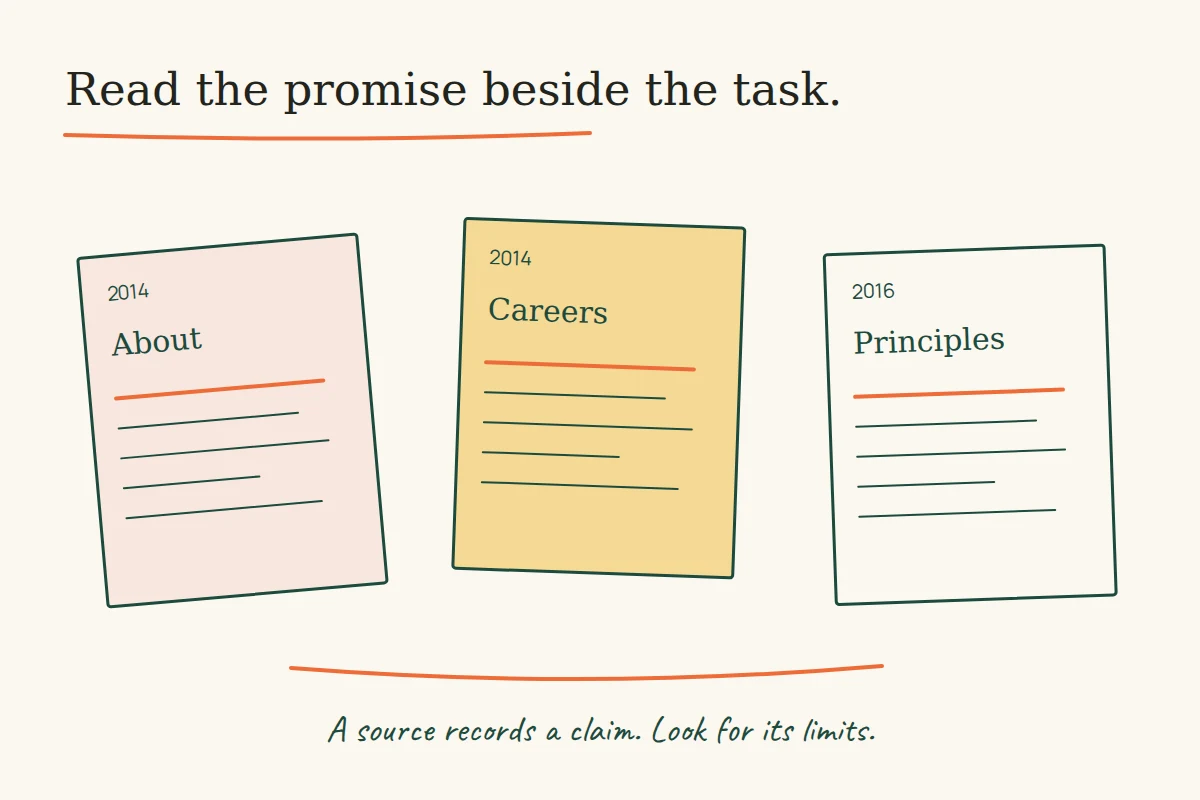
The old Uflix website described an ambitious studio. Its recruitment page offers a more specific view: converting Photoshop layouts to HTML, developing WordPress themes and plugins, building APIs, and producing raster and vector graphics. Reading the promotional pages alongside those responsibilities shows how the studio described its work and the people it hoped to recruit.
This is a historical account based on five retrieved pages captured between July 2014 and May 2016. The current Uflix Design Journal is an independent publication; it does not present these commissions, jobs or services as its own. Capture dates identify the archived versions we read, not the founding date of the business.
The homepage brought several kinds of work together
The homepage captured in July 2014 promoted website work, graphic design, hosting and mobile applications. A quotation form asked for a project title, a field of work and project details. Its options ranged from graphics and websites to mobile and desktop software.
The portfolio preview named projects including The Wondery, BRAY, Fredegårds, Lysmarine AB and a Paanchajanya banner. This mixture matters: the site presented both designed artifacts and software-related work, rather than a single type of commission. Several surviving descriptions now have separate editorial readings of their publishing features.
The form is evidence of how an enquiry was framed. It does not preserve a quotation, delivery schedule or completed customer transaction. Nor does the homepage’s claim to offer hosting establish the specifications or present availability of a hosting service.
The About page describes an approach, not a measured record
The About page captured in August 2014 grouped web, graphic, software and mobile-app work under an approach centred on understanding a client’s organisation. Its language stressed consultation, technical skills and tailored solutions.
That tells us how the studio wanted to position itself. It is not independent evidence of its reach, delivery quality or effects on a client’s business. The useful historical distinction is between an offered process and a documented result. A project brief can identify a feature that was advertised; a verified outcome would require a different kind of evidence.
The careers page makes the work more concrete
The recruitment page captured in November 2014 included three detailed role rows:
- Web developer: website development, conversion of Photoshop layouts to HTML, and WordPress theme and plugin development.
- Web application developer: application and API development.
- Graphic designer: raster editing and vector design, with Photoshop and Illustrator among the listed tools.
The advertised skill lists included PHP 5-era development, JavaScript, jQuery, HTML and CSS. These are historical requirements, not recommendations for a new software project. The form also offered “Software Developer” as a selection even though the retrieved responsibilities table did not include a corresponding detailed row. That mismatch is retained rather than filled with an invented job description.
Applicants were asked for their contact details, selected role, experience and a CV or résumé. These notices do not establish how many people were hired, who held a role or whether any vacancy remains open. There is no application form for the former studio on this historical page.
A later page connects design, usability and discovery
The web-design statement captured in May 2016 argued that a site’s appearance should relate to its purpose. It discussed page loading, clear structure, responsive layouts, browser support, search visibility and social promotion. It also encouraged visitors to inspect live examples rather than rely only on screenshots.
Some parts are useful as a record of the period’s design vocabulary. Other claims need stronger evidence before reuse. The page quoted short visitor waiting times without identifying the underlying survey; we have not adopted those figures as universal design thresholds. Its promotional account of social activity and search ranking likewise does not establish a causal ranking rule.
For a current project, Google’s SEO Starter Guide is a more appropriate starting point than an old agency sales page. It explains helping search engines understand content and helping people decide whether to visit; it does not promise that following a recipe guarantees indexing or first place. Historical positioning and current implementation guidance serve different purposes.
The contact page belonged to the former studio
The contact page captured in July 2014 named an office in Durgapur, West Bengal, and offered phone, email and a message form. That establishes what this captured page displayed. It does not verify that the old office, telephone hours or recipient is still available.
For the current publication’s purpose, see the journal introduction. The former contact details are not presented here as a current channel for commissioning work or submitting a job application.
Read the evidence at the right scale
Together, the pages show a studio marketing design and development across print and digital work, supported by more specific descriptions of publishing features and development tasks. They cannot supply a complete staff history, client outcome record or account of every service.
The practical way to explore the surviving work is to start with the artifact: a recovered lighting-catalogue spread, two travel-site briefs, or the preserved SMS client source package. Each supports a different kind of observation. Keeping those differences visible makes the history more useful than repeating the old promotional claims.